
Spam Score: what Moz's metric is and how to assess a domain's risk
By Tiago CostaUpdated on July 2, 2026

Spam Score is a Moz metric that shows, as a percentage (from 1% to 100%), how much a domain resembles sites that have already been penalized. In practice, Spam Score:
- estimates a domain's risk of penalization;
- is based on dozens of suspicious signals common to banned sites;
- the lower, the better: low values indicate low risk;
- is not used by Google, it serves as a warning for your own analysis.
What Moz's Spam Score is
Spam Score is a metric developed by Moz, one of the best known SEO tools on the market, to estimate the likelihood of a domain being penalized by search engines. It is expressed as a percentage: the higher it is, the greater the site's resemblance to pages that Moz has already identified as penalized or banned.
The idea behind the metric is comparative. Moz keeps a huge index of sites and observes which of them get penalized over time. From there, it identifies the signals that these problematic sites tend to share and checks how many of them appear on any domain analyzed.
It is important to make one thing clear from the start: Spam Score is not a Google metric, and the search engine itself does not use it to rank. It is a third party estimate, useful as a risk thermometer when evaluating a site, yours or that of a potential link partner.
How Spam Score is calculated
Spam Score is born from a list of warning signals, the so called spam flags. These are traits that, on their own, may be innocent, but which, added together, appear frequently on low quality or penalized sites. Moz analyzes dozens of these signals with a statistical model and returns a risk percentage.
Among the most common signals tend to be:
- a low quality or artificial backlink profile;
- a strange ratio between links received and real content;
- little content or many thin pages;
- an excess of external links pointing outward;
- the absence of contact and about pages and other trust signals.
The result is translated into a percentage scale. Keep in mind that the metric is probabilistic: a high Spam Score does not prove that a site is spam, it only indicates that it statistically resembles sites that were penalized.
What a good Spam Score is
There is no magic number, but there are widely used reading ranges. In general:
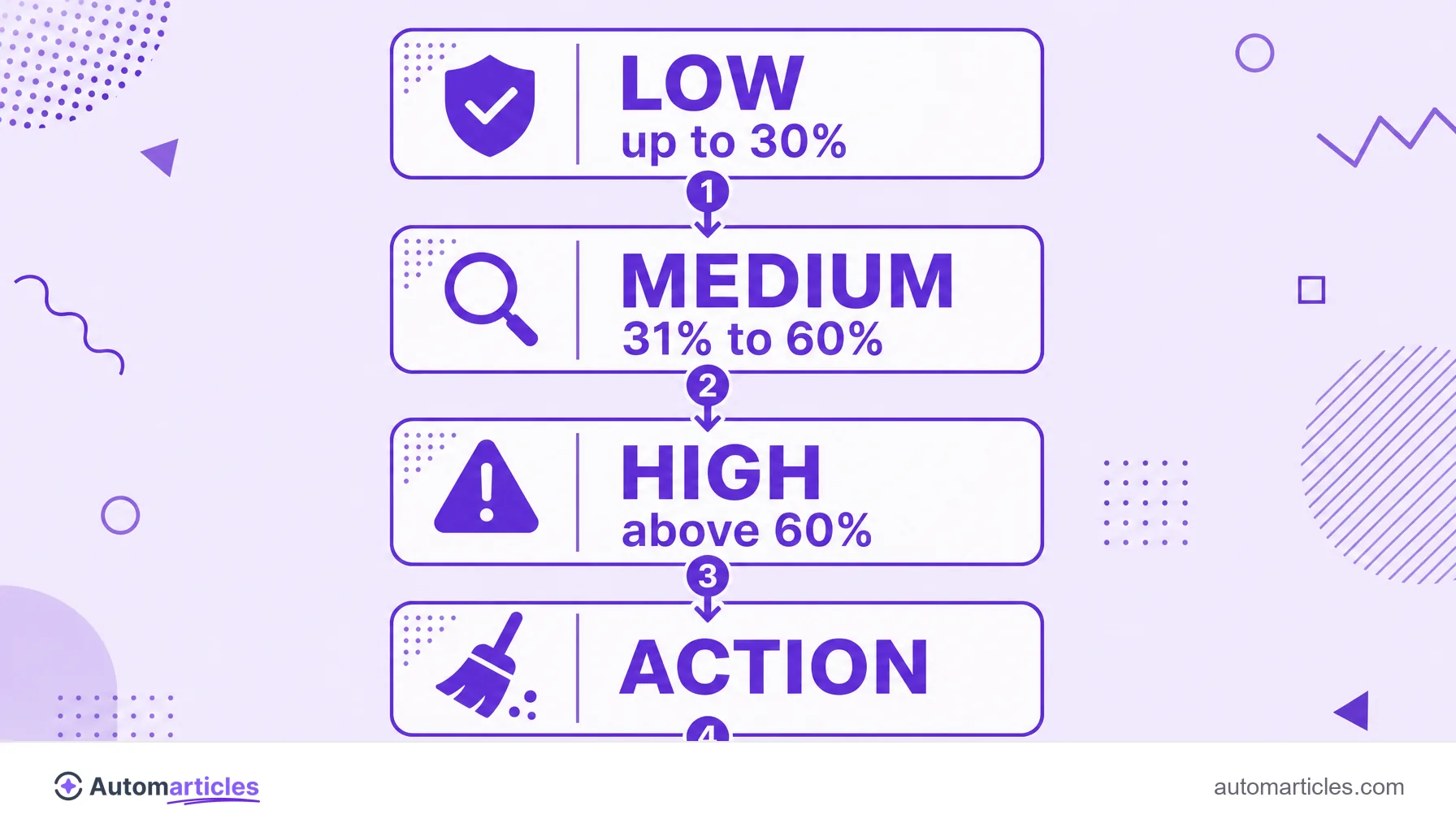
- Low risk: a Spam Score below 30% is usually considered healthy.
- Medium risk: between 31% and 60%, it is worth investigating the link profile carefully.
- High risk: above 60%, the domain calls for immediate attention and a cleanup of the profile.
These ranges are a guide, not a sentence. A legitimate site may have a slightly elevated Spam Score due to technical details, while a problematic site may go unnoticed. That is why the number is there to raise an eyebrow and open an investigation, never to condemn a domain on its own.
The most valuable use of the metric is comparative: assessing the Spam Score of sites you are thinking of getting a link from. A link coming from a link farm or from a domain with a very high score can bring more risk than benefit.
Spam Score, Domain Authority and Domain Rating
Spam Score is rarely read on its own. It pairs with domain strength metrics, which measure a site's positive potential, while Spam Score measures the negative risk. The two readings together give the full picture.
- Domain Authority: domain authority is Moz's metric that estimates a site's ranking strength on a scale of 1 to 100.
- Domain Rating: Domain Rating is the Ahrefs equivalent, focused on the strength of the backlink profile.
An ideal domain combines high authority with a low Spam Score. Beware the classic trap: a site may show generous authority and still hide a high Spam Score because of an artificially inflated link profile. Looking only at the strength, without checking the risk, leads to poor partnership and link building decisions.

How to lower a domain's Spam Score
Lowering the Spam Score is, in practice, cleaning up the signals that make the site resemble spam. A routine that works:
- Audit the link profile: map the backlinks pointing to your site and identify toxic or irrelevant domains.
- Disavow the worst ones: the disavow tool lets you ask Google to ignore harmful links you cannot remove.
- Strengthen the content: about pages, contact pages and real, useful content move the site away from the spam profile.
- Avoid artificial exchanges: steer clear of bulk link schemes and partners with a high score.
- Monitor frequently: track the number over time to catch reputation drops early.
Keep in mind that Spam Score is recalculated periodically by Moz. Improvements to the link profile take time to reflect in the metric, so the cleanup is ongoing work, not a one day fix.
A domain's Spam Score is not the same as email spam
A very common confusion: Moz's Spam Score has nothing to do with an email's spam score. Because many people search for spam score thinking about email marketing campaigns, it is worth separating the two concepts once and for all.
- Domain Spam Score (Moz): measures the risk of a site being penalized in search engines, based on the link profile and the quality of the pages.
- Email spam score: deliverability testing tools assess whether a message is likely to land in the spam folder, looking at the content, the authentication and the sender's reputation.
They are metrics from different worlds: one is about SEO and site reputation, the other is about email marketing and deliverability. In this glossary, Spam Score always refers to Moz's metric for domains.