
Domain authority: what it is and why it matters for SEO
By Tiago CostaUpdated on July 2, 2026

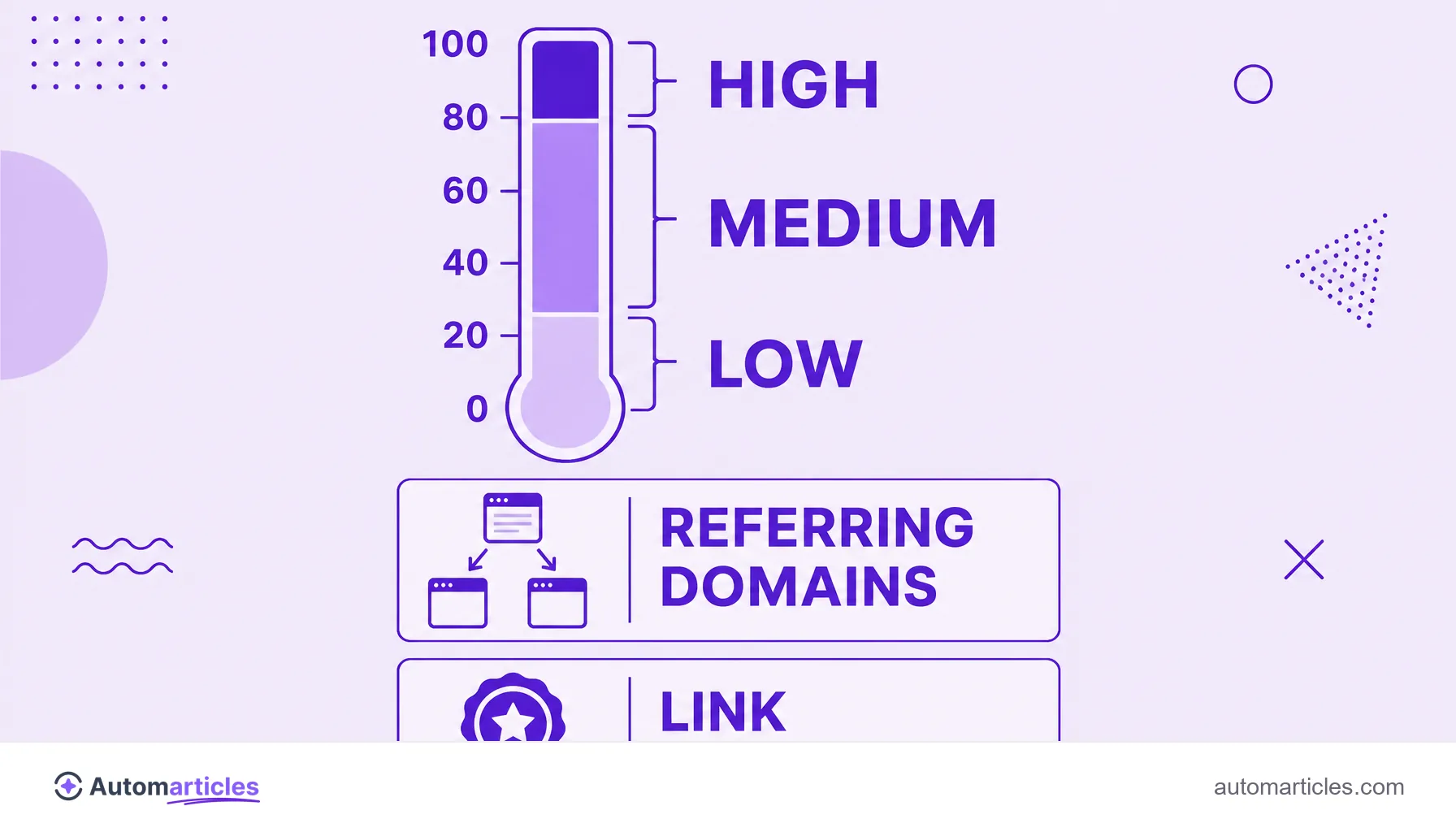
Domain authority (DA) is a Moz metric, from 0 to 100, that predicts a site's strength in search results. In short:
- it is calculated from the domain's backlink profile;
- it uses a logarithmic scale, so climbing the last points is the hardest part;
- it is used to compare your site with your competitors;
- it is not an official Google ranking factor, but an estimate.
What domain authority is
Domain authority (DA) is a score from 0 to 100 created by Moz to predict how likely a site is to appear well in search results. The higher the score, the greater the estimated strength of the domain as a whole, not of a single page.
The idea was born to give SEO professionals a simple number that sums up something quite complex: a site's ranking power. Instead of analyzing hundreds of signals one by one, you look at a single indicator and can quickly compare two domains. Much of that calculation comes from the site's backlink profile, that is, from how many and which other domains point to it.
A vocabulary note: domain authority is not the same as registering a domain (the site's address). Here, the term always refers to the metric of ranking strength, a core concept in off-page SEO.
How domain authority is calculated
Moz calculates DA with a machine learning model that looks at dozens of factors tied to the link profile, the main ones being the number of referring domains (distinct sites that link to you) and the quality of those domains. The score is normalized on a logarithmic scale, which explains why it is relatively easy to go from 10 to 20 and very hard to move from 80 to 90.
The weight of links in the calculation is not arbitrary. In a study of 11.8 million search results, Backlinko found that the number of referring domains pointing to a page is the factor with the strongest correlation to good positions, ahead of any other signal analyzed. In other words, the logic of counting link votes, which also underlies PageRank, is what supports metrics like domain authority.
Because DA is comparative, it has no absolute target value. A new niche blog can compete well with a score of 25, while in a contested sector such as finance a 25 is considered weak. What matters is your score relative to the competitors that appear for your keywords.
Is domain authority a Google ranking factor?
No. This is the most common misunderstanding about the topic. Domain authority is a proprietary Moz metric, calculated externally, and Google does not use that number to position pages. Google itself has stated several times that there is no single authority score inside the algorithm.
So why is the metric useful? Because it tries to approximate the result of several real signals the search engine does consider, especially those tied to links and reputation. A high DA usually goes hand in hand with a good backlink profile and with quality signals similar to those behind E-E-A-T, the set of experience, expertise, authoritativeness and trust criteria.
The correct reading, therefore, is to treat DA as a diagnostic and comparison thermometer, never as the number Google looks at to decide your ranking. It is an approximate mirror, not the official ruler.
DA, DR and Authority Score: the different authority metrics
Every major SEO tool has its own authority metric, with similar names and scales but different calculations. That is why the numbers are not interchangeable: comparing one site's DA with another's DR makes no sense.
| Metric | Tool | What it estimates |
|---|---|---|
| Domain Authority (DA) | Moz | Overall domain strength to rank, from 0 to 100. |
| Domain Rating (DR) | Ahrefs | Strength of the domain's backlink profile, from 0 to 100. |
| Authority Score | Semrush | Overall quality and authority, combining links, traffic and spam signals. |
In practice, they all measure similar things through different paths. The best move is to pick one tool, track how its metric evolves over time and always compare against competitors measured by the same ruler.
How to raise your domain authority
Because domain authority is driven by links and quality, there is no shortcut: you raise it by improving the same fundamentals that make a site truly climb on Google. The most effective paths are:
- Earn good backlinks: consistent link building, with editorial links from relevant sites, is what moves the needle the most.
- Build topical authority: covering a subject in depth, with many connected pieces of content, helps you become a reference and attract natural links, the principle of topical authority.
- Produce link worthy content: complete guides, original data and free tools are the formats that earn the most spontaneous citations.
- Clean up toxic links: a profile full of spam links drags down trust. Monitoring your spam score and removing or disavowing bad links protects your authority.
An important warning: avoid shortcuts such as buying links in bulk. Beyond risking a Google penalty, these artificial links rarely sustain real authority gains over time.

How to check a site's authority
You do not need to guess authority: several tools show that number in seconds. The most used are:
- Moz: the original source of DA, with the toolbar and Link Explorer to check any domain.
- Ahrefs: shows Domain Rating and a detailed report of the backlink profile.
- Semrush: shows the Authority Score alongside traffic and keyword data.
Many of these platforms offer free checkers for a quick look. The most valuable thing, though, is not the isolated number but the trend: tracking whether your authority rises month over month and how it compares with the competitors fighting for your keywords.