
Keyword density: what it is and the ideal level for SEO
By Tiago CostaUpdated on July 2, 2026

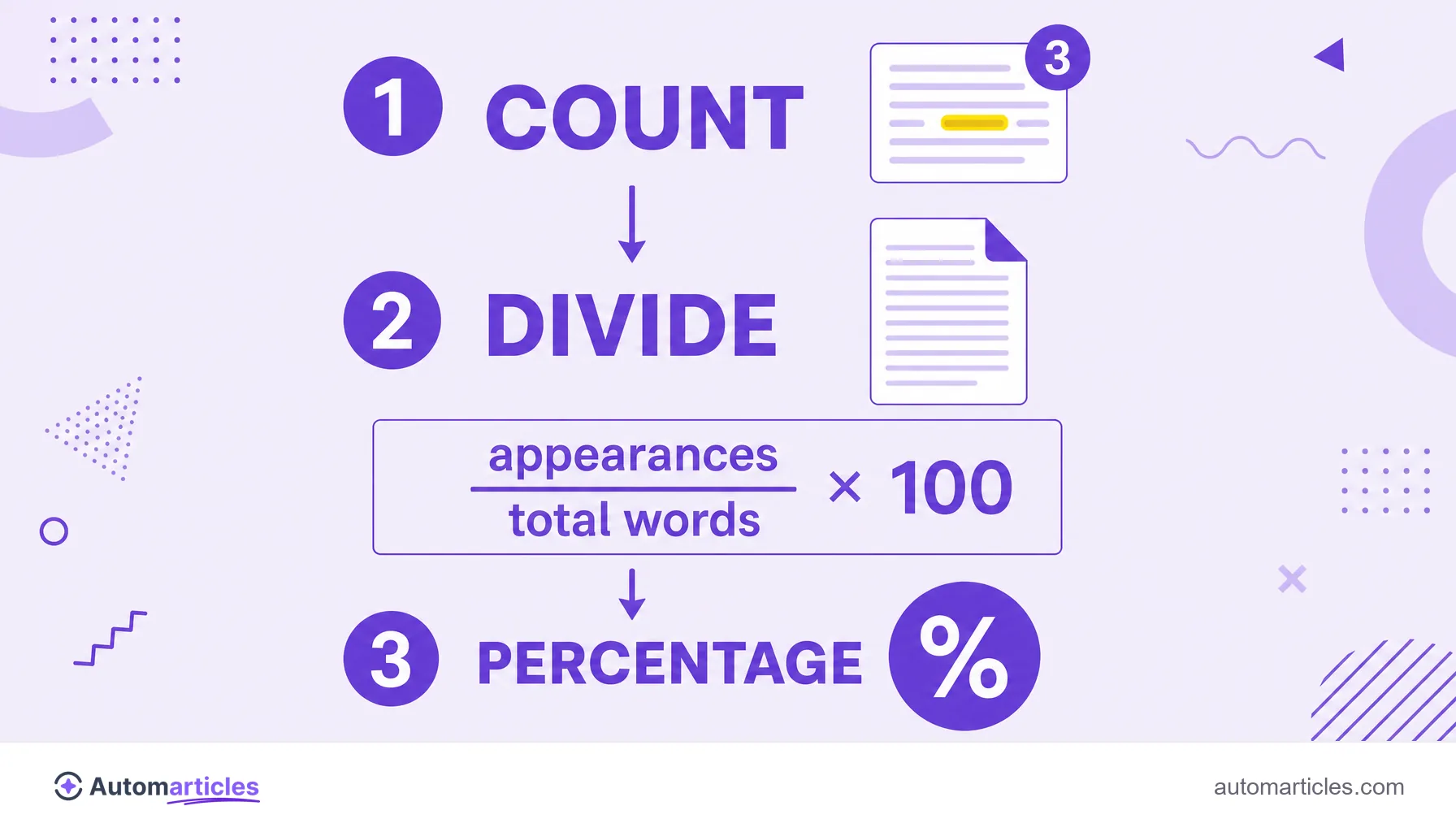
Keyword density is the percentage of times a term appears out of the total words in a text. You calculate it like this:
- count how many times the keyword appears;
- divide by the total number of words in the text;
- multiply by 100 to get the percentage;
- there is no fixed ideal value: the focus is naturalness, not a number.
What keyword density is
Keyword density measures how many times a keyword appears in a piece of content, relative to the total number of words. The result is a percentage: if a thousand word text uses the target term ten times, the density is 1%.
The metric was born in the early days of SEO, when search engines were simpler and counted repetitions to decide what a page was about. Repeating the word many times once worked as a shortcut to rank. Those days are gone. Today density is just one diagnostic among many, useful to check whether you forgot to mention the topic or overdid it, never a number to chase.
How to calculate keyword density
The math is simple and you can do it by hand. The formula is:
Density = (keyword appearances / total words) x 100
Here is a practical example. An article has 800 words and uses the target expression 12 times. The density is (12 / 800) x 100, that is, 1.5%. Some details change the result and are worth keeping in mind:
- Do variations count? Tools usually consider the exact match, but Google understands plurals, synonyms and close forms as part of the same topic.
- Compound terms: in a keyword of two or three words, density is measured by the whole phrase, not by each loose word.
- Where it appears matters more than how many times: the word in the title, in the first paragraph and in a subheading weighs more than the same word repeated in the middle of the text.
Is there an ideal keyword density?
The short answer is no. There is no magic number that guarantees ranking, and Google has never published a recommended percentage. The references that float around, like the range of 1% to 2%, only serve as a comfort zone to avoid excess, never as a target to hit.
The data reinforces this idea. In a study of 11.8 million search results, Backlinko found no correlation between using the exact keyword in on-page elements, such as the title tag, and better positions on the first page. In other words: forcing the repetition of the term does not make the site climb. The search engine has evolved to understand the subject of a text from the whole context, not from a word count.
This does not mean ignoring the keyword. It still helps make the topic clear, especially in strategic spots such as the title and the introduction. The right adjustment is one of mindset: write for the person, use the term where it fits naturally and let density be a consequence, not a goal.
The danger of excess: keyword stuffing
If chasing a high density does not help, overdoing it truly hurts. Filling the text with artificial repetitions is the practice known as keyword stuffing, and it violates Google's guidelines. Besides making the reading choppy and driving the visitor away, it can trigger a penalty that sinks the site in the results.
The problem also targets the reading experience. A text that repeats the same expression in every paragraph sounds robotic and hurts readability, precisely the opposite of what the search engine wants to reward. The practical rule is honest: if the repetition sounds forced when you read it aloud, it is probably hurting, not helping.

What to do instead of chasing density
Instead of counting appearances, modern SEO aims at relevance and topic coverage. A few practices pay off far more than tweaking a percentage:
- Use variations and synonyms: alternating between the exact term, plurals and close expressions sounds natural and reinforces the subject without repeating the same word.
- Cover the topic in depth: addressing subtopics and related questions signals depth, something connected to semantic SEO, focused on meaning rather than exact words.
- Consider term relevance: concepts such as TF-IDF and LSI help you think about which associated words give context to your main topic.
- Prioritize the highlight spots: make sure the keyword is in the title, the first paragraph and at least one subheading, spots that signal the topic more strongly.
In the end, density is a common sense check within on-page SEO, not a ranking factor on its own. Good content covers the subject completely and uses the target term where it makes sense, without anyone needing to count.
Tools to measure keyword density
If you want to check the percentage of your text, several tools do the math automatically and even show the most frequent words:
- Free density analyzers: online platforms where you paste the text or the URL and get the list of terms and their percentages.
- Semrush, Ahrefs and Surfer: SEO tools that compare your content with that of competitors who already rank and suggest terms to include.
- SEO plugins: extensions for content editors that flag the keyword frequency while you write.
Use these numbers as a thermometer, not a target. If the density is near zero, you may not have made the topic clear; if it is very high, it is time to ease the repetition. Between those two extremes, trust smooth reading more than the calculator.