
LSI: what latent semantic indexing is in SEO
By Tiago CostaUpdated on July 2, 2026

LSI (Latent Semantic Indexing) is a mathematical technique that relates words by how often they appear together across many texts. In SEO, the term is used, loosely, to describe words semantically related to the main topic. Google states it does not use LSI, but covering a subject well with its related terms remains good practice.
What LSI (Latent Semantic Indexing) is
LSI stands for Latent Semantic Indexing. It is an information retrieval technique patented in the late 1980s that analyzes a large collection of documents to discover hidden (latent) relationships between words.
The core idea is simple: terms that often appear in the same contexts tend to have related meanings. By mapping these co occurrence patterns, the system can bring words like car, vehicle and automobile close together, even without any dictionary telling it that they are similar.
A context note: the acronym LSI also names language schools and companies in very different fields. In this entry, LSI always means the latent semantic indexing technique applied to search and SEO.
The myth of LSI keywords
At some point, the SEO community started calling any term related to the main subject, such as synonyms and variations, LSI keywords. The name caught on, became a tool feature and even a content category. The problem is that it mixes up two different things.
The original LSI was created for small, static document collections, nothing like the scale and dynamism of today's web. That is why Google itself debunks the idea. In public statements, Search Advocate John Mueller said there is no such thing as LSI keywords and that anyone recommending them is mistaken.
The practical takeaway is not to ignore related terms, but to stop treating them as a magic formula called LSI. What works is genuinely covering the topic, with the natural vocabulary of someone who knows the subject.

LSI and semantic SEO: how they relate
Although Google does not use LSI, it has come a long way in understanding meaning. With systems like BERT and MUM, the engine understands context, entities and the relationship between concepts, far beyond matching the exact query word to the exact page word.
That is where semantic SEO comes in, the practice of optimizing by meaning and by topics, not just by isolated words. In practice, it borrows the correct intuition behind the LSI idea (use the natural vocabulary of the topic) and applies it with Google's modern tools.
In other words: the LSI label is dated, but the care to write with semantic richness, covering subtopics and terms an expert would use, is still very valid.
How to find semantically related terms
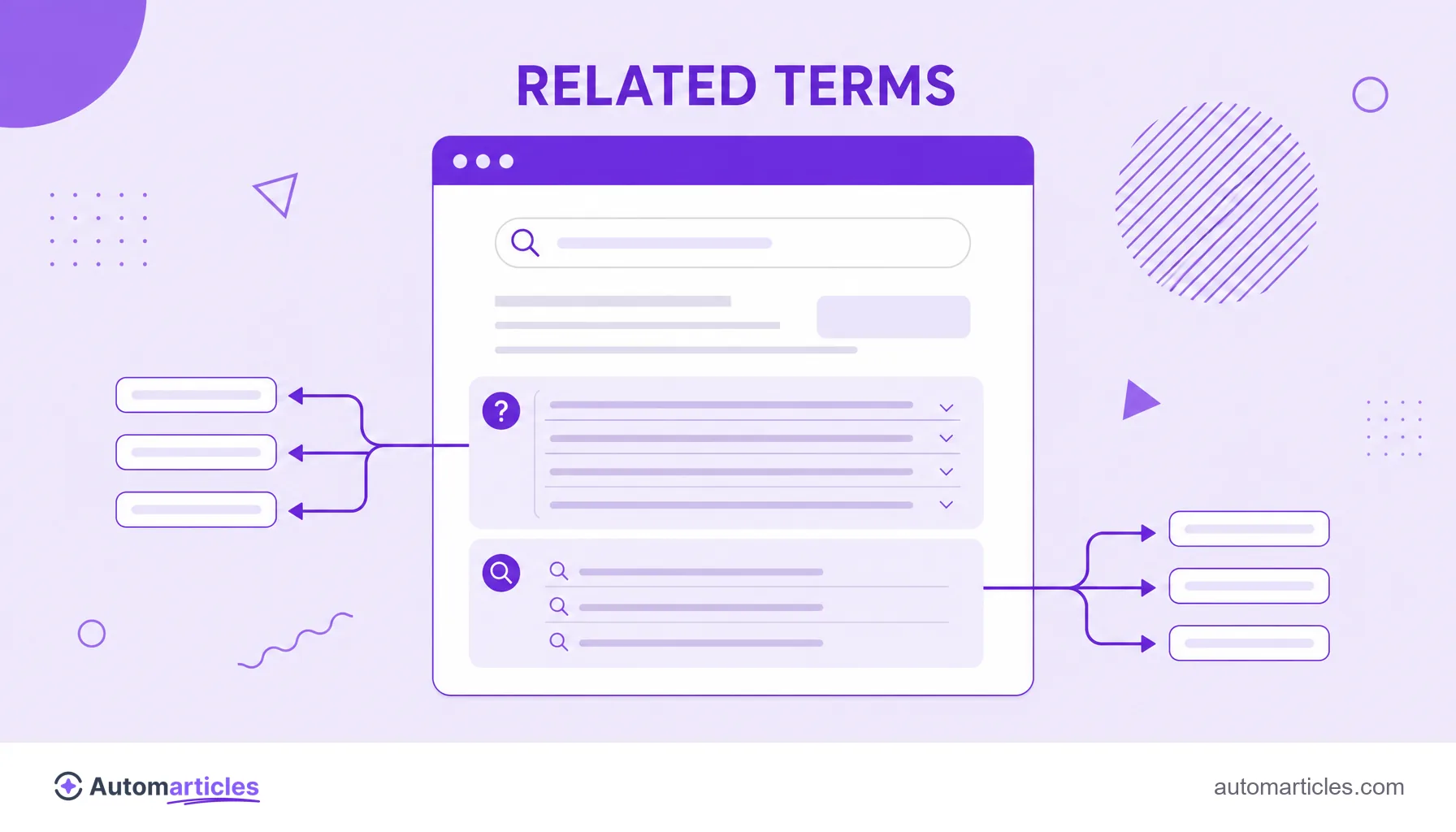
If the goal is to cover a topic well, there are far more reliable sources than a generic list of LSI keywords. The SERP itself delivers much of that map:
- People Also Ask: the related questions show doubts and subtopics that the audience associates with the topic.
- Related searches: the suggestions at the bottom of the page reveal variations and connected intents.
- Autocomplete: the search suggestions as you type point to popular terms around the word.
- Well ranked competitors: the subheadings of the top pages show the subtopics Google already values.
A good keyword research organizes these findings into subtopics, instead of turning into a loose list of synonyms to squeeze into the text.
How to use related terms in your content (without keyword stuffing)
Having a list of related terms does not mean forcing them into the text. The rule is always naturalness: they should appear because the subject calls for them, not because a tool ordered it.
- Write by subtopic: as you explain each facet of the topic, the related terms show up on their own.
- Prioritize readability: if a sentence sounds artificial just to fit a word, rewrite it.
- Avoid forced repetition: piling up variations is excessive keyword density, something Google reads as manipulation.
- Use variations fluidly: alternating synonyms makes the text lighter and equally understandable for the engine.
In short, the best semantic content does not look optimized. It simply covers the subject completely, with the vocabulary of someone who truly masters the topic.
LSI, TF-IDF and other relevance techniques
LSI is not the only acronym the SEO community borrows from information retrieval. Another well known one is TF-IDF, which weighs the importance of a term in a document against a large set of texts.
It is worth understanding the difference. TF-IDF looks at the relative importance of each word; LSI seeks latent relationships between words from co occurrence patterns. Both are useful as intuition, but neither faithfully describes what Google does today, which relies on much more sophisticated language models and semantic vectors (embeddings).
The lesson that survives is conceptual: meaning matters more than the exact word. Writing for the topic, and not for a single expression, is what brings your content closer to how modern search engines understand the world.