
Keyword research: what it is and how to do it
By Tiago CostaUpdated on July 2, 2026

Keyword research is the process of finding and prioritizing the terms your audience searches for. A basic flow involves:
- gathering ideas from seed keywords;
- expanding the list with suggestion tools;
- evaluating volume, difficulty and intent;
- grouping and prioritizing terms by opportunity.
What keyword research is
Keyword research is the work of finding out which terms people use to search for a topic and deciding which of them are worth betting on. Each keyword is a clue about what the audience wants, and mapping those clues is what guides all content production.
More than a list of terms, research delivers priorities. It crosses the audience's interest (how much is searched), the competition (how hard it is to rank) and the search intent (what the person expects to find) to separate good opportunities from the ones that take a lot of work for little return.
Without this step, it is easy to write about what you find interesting, rather than what people are actually looking for. Keyword research is what connects your production to the demand that already exists.
Why keyword research matters
Researching before writing avoids waste. Much of the content published on the web never gets visits precisely because it targets the wrong or overly competitive terms. An Ahrefs study, which analyzed billions of pages, found that 96.55% of them get no organic traffic from Google.
Another finding helps explain where the opportunities are. According to the same Ahrefs, 92.42% of all search terms get ten searches a month or fewer. In other words, most of the demand is spread across a multitude of specific searches, not in the few generic, high-volume words.
That is why research matters: it helps you find long-tail terms, easier to rank and often with clearer intent, instead of fighting only over the most contested words.
How to do keyword research step by step
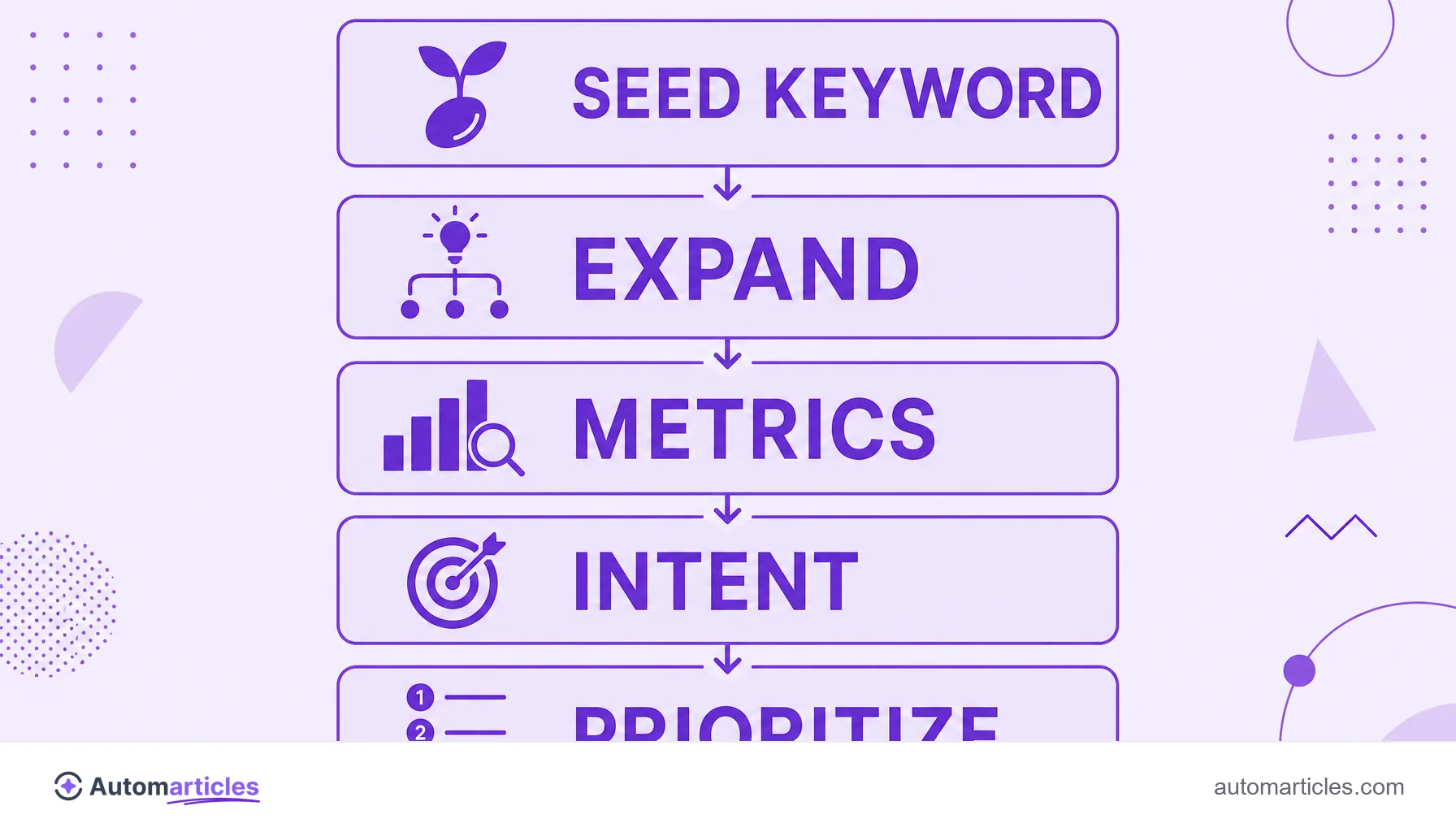
A simple flow handles most cases. The path usually is:
- 1. List seed keywords: start with the core terms of your topic, the so-called seed keywords.
- 2. Expand the list: use suggestion tools, People Also Ask and related searches to broaden the ideas.
- 3. Collect the metrics: note the search volume and the difficulty of each term.
- 4. Classify by intent: understand whether the search is informational, commercial or transactional.
- 5. Prioritize: pick the terms with a good balance of volume, difficulty and alignment with your goal.
At the start, aim for more specific, less contested terms. They deliver the first results and build the authority that later helps you compete for bigger words.
The metrics that guide the choice
Not every keyword is worth the same effort. Four metrics help compare opportunities:
| Metric | What it indicates |
|---|---|
| Search volume | How many people search for the term each month |
| Difficulty | The estimated effort to rank against the competition |
| Intent | What the person expects to find when searching |
| Traffic value | The term's potential return for the business |
The sweet spot usually lies in terms with reasonable volume and low difficulty, aligned with the right intent. High volume is worth nothing if the page never reaches the top, nor if the intent does not match what you offer.

Keyword research tools
There are options for every budget, from free to paid. The most used:
- Google Keyword Planner: free, shows ideas and volume ranges inside Google Ads.
- Google Trends: compares interest in terms over time and by region.
- Ubersuggest and Answer the Public: good for broadening ideas and seeing the audience's questions.
- Semrush and Ahrefs: paid, with detailed data on volume, difficulty and competition.
One tip that costs nothing: Google itself. Autocomplete, People Also Ask and related searches reveal real variations and questions without leaving the results page.
From keyword to content: group and prioritize
Collecting terms is only half the job. Then you need to turn them into a content plan. The way to do it is to group words that answer the same intent and distribute them across pages, avoiding two texts fighting over the same term, a problem known as keyword cannibalization.
Organizing these groups into a content cluster helps cover a topic in depth and build authority in Google's eyes. Before writing, it is still worth doing a SERP analysis of the chosen term, to confirm the format and intent the page needs to serve.