
Guest post: what it is and how to use it to earn backlinks
By Tiago CostaUpdated on July 2, 2026

A guest post is an article published on someone else's site, and it serves to:
- earn a quality backlink pointing to your site;
- reach a new, qualified audience;
- build authority and reputation in your niche;
- generate referral traffic straight from the published content.
What a guest post is
A guest post is an article you produce to be published on someone else's blog or site, with your name as the guest author. The word guest means exactly that: you are invited (or you pitch) to contribute content on a site that is not yours.
The logic is a trade that benefits both sides. The site that receives the article gets quality content without having to produce it, and you, the guest author, gain exposure to that site's audience and, almost always, a backlink pointing to your own site. It is this combination of audience and link that makes the guest post a core piece of any link building strategy.
Do not confuse a guest post with a regular post on your blog. The difference is not in the format of the text, but in where it is published: a guest post lives on a third party's site, while a normal post stays on your domain. It is this change of address that generates the external link and the exposure to a new audience.
Why guest posts matter for SEO (the power of the backlink)
The SEO value of a guest post comes almost entirely from the backlink. For Google, a link from another site works as a vote of confidence, and sites with more quality votes tend to rank better. It is no accident that links remain among the strongest signals in the algorithm.
The numbers help put this in perspective. In a study of 11.8 million search results, Backlinko found that the first result on Google has, on average, 3.8 times more backlinks than the pages ranking from the second to the tenth position. On the flip side, Ahrefs measured that 96.55% of all pages receive no organic traffic from Google, often for lack of links and authority.
This is where the guest post comes in. By earning relevant backlinks on sites in your niche, you strengthen the domain authority of your pages and improve the odds of appearing well in search. The gain is not only about position: each link can also bring referral traffic from readers who see the article and click.
Guest posts for SEO and for audience: the two goals
A good guest post pursues two goals at the same time, and it is a mistake to aim at only one of them. The first is the SEO goal: the backlink that strengthens authority and helps rankings. The second is the audience goal: reaching new readers, building reputation and generating qualified traffic straight from the content.
Those who aim only at the backlink end up producing weak texts, on irrelevant sites, that convince no one and even risk a penalty. Those who aim only at the audience forget to secure the well-placed link and lose the SEO return. The sweet spot is to write for real people, on real sites, with a link that feels natural in context.
This dual goal also reinforces your experience, expertise, authoritativeness and trustworthiness. Appearing as a guest author in respected outlets in your industry is a reputation signal that goes beyond the link, and one that both readers and Google notice.
How to do a guest post step by step
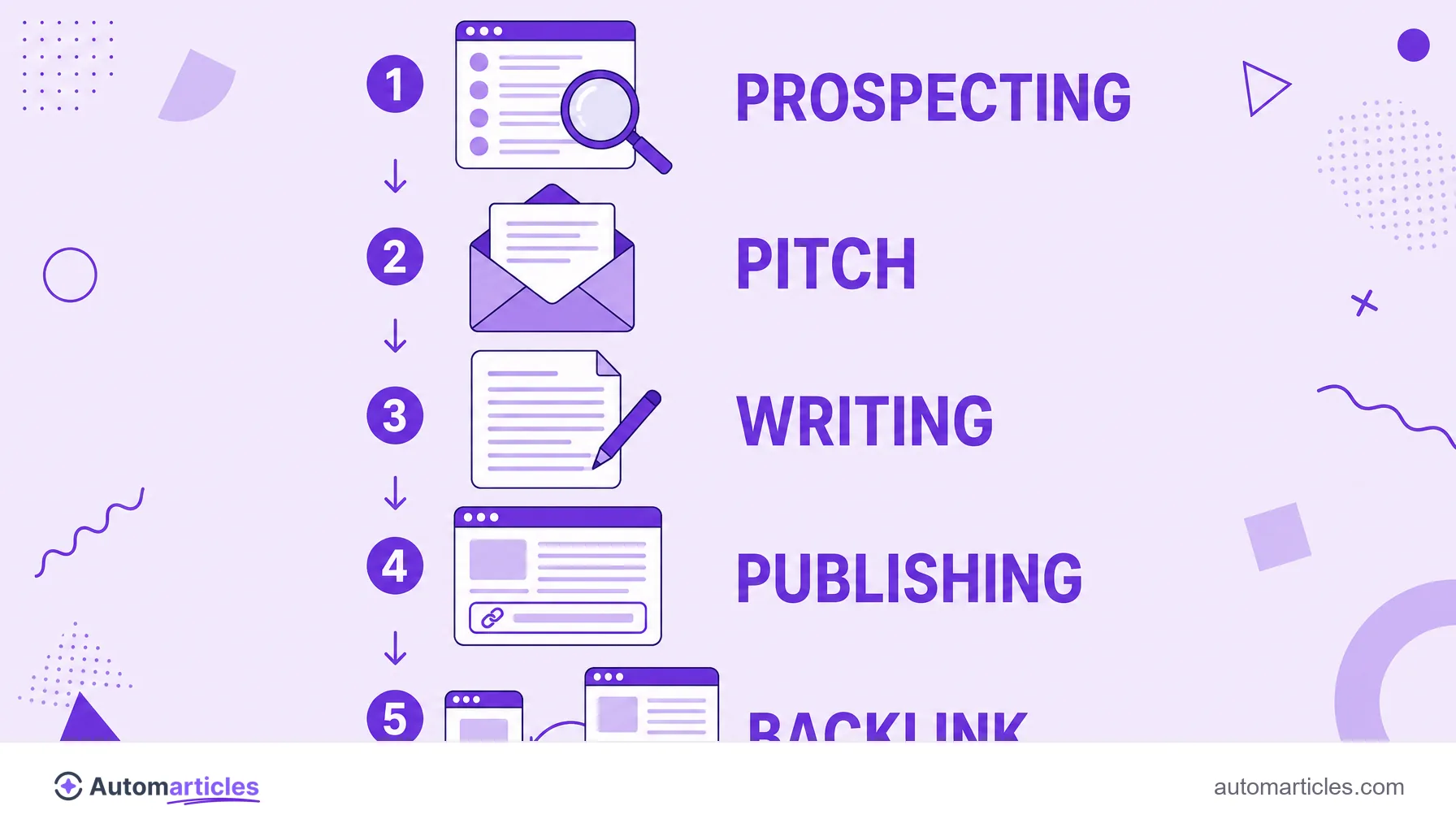
Doing a guest post is a process of prospecting and relationship building, not mass sending. A routine that works:
- Define the goal and the audience: decide which page you want to strengthen and what kind of audience you want to reach.
- Prospect relevant sites: build a list of blogs and outlets in your niche that accept guests and have a real audience.
- Study the site and propose topics: read what they have already published, find content gaps and suggest topics not yet covered.
- Send a personalized pitch: introduce yourself, show that you know the site and propose two or three focused topic ideas.
- Write excellent content: deliver an original, useful article, with the link to your site placed naturally in the right anchor text.
- Follow up after publishing: reply to comments, promote the post and keep the relationship going for future collaborations.
Personalization is everything. A generic pitch sent to a hundred sites converts far less than ten well-crafted proposals for sites you actually studied.

How to choose good guest post sites (and avoid link schemes)
Not every backlink helps, and some can even hurt. The quality of the site that publishes your guest post matters more than the number of posts you land. Some signs of a good partner:
- Topical relevance: the site covers your subject or a close one, and its audience fits your target.
- Real authority: metrics like Domain Rating help estimate the strength of the domain, but also look at real traffic and engagement.
- Careful editorial: the site reviews what it publishes, does not accept just any text and is not crammed with sponsored posts without standards.
- Natural links: the site uses ordinary links within the content, not a pile of paid links flagged only to manipulate rankings.
Steer clear of networks of sites built only to sell links, the so-called link farms and PBNs. Buying links in bulk or publishing on sites with no audience is a risky approach to building links that violates Google's guidelines and can earn a penalty instead of a result.
Common mistakes and best practices for guest posts
After years of abuse, the guest post got a bad reputation when done only to manipulate rankings. Doing it well, today, means avoiding a few classic mistakes:
- Forced anchor text: stuffing the link with the exact keyword looks like manipulation. Prefer a descriptive, natural anchor within the sentence.
- Thin, duplicated content: reusing the same article across several sites destroys the value. Each guest post should be unique and useful.
- Irrelevant sites: publishing outside your niche just to get a link does not fool Google and does not attract the right audience.
- Volume above all: many bad links weigh less, and can cost more, than a few truly good ones.
The best practice is easy to state and hard to execute: write the best possible content, for the best possible site, with an honest link in context. Done that way, the guest post remains one of the most efficient ways to add authority and reach to your organic traffic.