
Share of Voice in AI: what it is and how to measure your slice of mentions in answers
By Tiago CostaUpdated on July 2, 2026

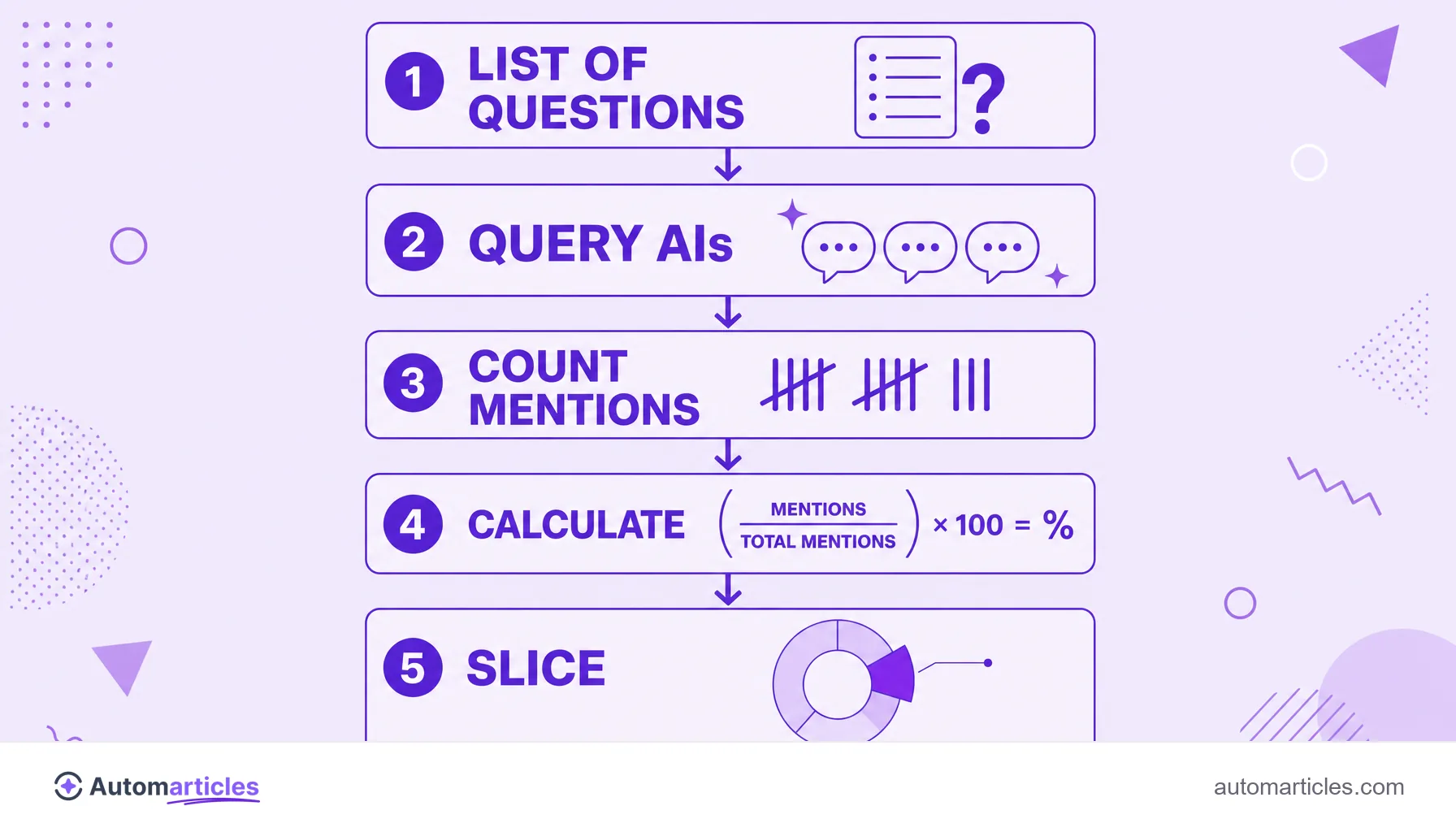
Share of voice in AI is a brand's slice of mentions in AI answers relative to competitors. To measure it, you:
- define a list of questions from your niche;
- ask the same questions across several AIs;
- count how many times each brand is cited;
- calculate your slice of the total mentions.
What share of voice in AI is
Share of voice in AI (SoV in AI) is the share of mentions your brand receives inside AI-generated answers, compared with the total mentions of all brands in your market. Instead of measuring position in a list of links, it measures presence inside the text the AI delivers.
The idea comes from traditional share of voice, which estimates a brand's visibility against competitors in a channel, such as media or search. What is new is the stage: now what counts is showing up when ChatGPT, Gemini, Perplexity or the AI Overviews answer a question from your niche.
In practice, it is one of the main indicators of AI visibility. If, whenever someone asks "what is the best tool for X", the AI cites three competitors and never you, your share of voice in AI is zero, even if your traditional SEO is doing well.
How to calculate share of voice in AI
The math follows the usual share of voice logic, adapted to AI answers: divide your brand's mentions by the total mentions of all brands and multiply by 100.
Share of voice in AI = (your brand's mentions / all brands' mentions) x 100.
An example: you build a list of 50 questions from your sector and ask them to ChatGPT and Gemini. Adding up the answers, the market's brands were cited 200 times in total, and yours appeared in 30 of them. Your share of voice in AI is (30 / 200) x 100, that is, 15%.
Two decisions define the quality of the measurement: the list of questions, which needs to reflect what your audience actually asks, and the set of competitors considered. Changing either one changes the result, so it is worth keeping the same standard to compare the evolution over time.
Traditional share of voice vs share of voice in AI
Both measure a slice of presence, but on different ground:
| Aspect | Traditional share of voice | Share of voice in AI |
|---|---|---|
| Where it measures | Media, social and organic search | AI assistant answers |
| What counts | Impressions, positions and clicks | Brand mentions and citations |
| Data source | Media and SEO tools | Queries to AIs and monitoring |
The traditional one asks "how much of the media space is mine". The AI one asks "when the machine answers, how often does it remember me". They are complementary, and a brand that is strong in the first can still have weak presence in the second, because the models pick sources by their own criteria.
Why share of voice in AI matters
Share of voice in AI gained weight because generated answers now mediate more and more searches. When the AI answers instead of showing links, appearing in that answer becomes a direct fight with competitors.
The numbers show the size of the stage. According to the AI Overviews study by Semrush, which analyzed more than 10 million keywords, Google's AI summaries appeared in almost 25% of searches by mid-2025, settling around 16%. That is a huge slice of queries where the user's decision passes first through the machine's answer.
In this scenario, measuring only organic position tells half the story. Share of voice in AI reveals whether your brand is present exactly where attention is migrating, and lets you react before losing space to whoever the models already cite.

How to measure share of voice in AI in practice
You can start manually and evolve toward automation:
- Build the list of questions: gather the queries your audience makes, including comparisons and recommendation requests like "best X for Y".
- Query several AIs: run the same questions in ChatGPT, Gemini and Perplexity, because each model cites different sources.
- Count the mentions: record how many times your brand and each competitor appear, the basis of AI brand mention.
- Track the citation: note when your brand is cited as a source, the core of AI citation.
- Use monitoring tools: AI visibility platforms automate this collection and show the slice's evolution over time.
Improving the result is content work. Investing in LLMO and in optimization for generative engines, with clear answers, data and authority, is what makes your brand remembered more often when the AI answers.
Watch out: why share of voice in AI can mislead
The indicator is useful, but it demands careful reading so it does not become a loose number:
- Answers vary: the same question can generate different citations on each query, so a single measurement says little. The ideal is to repeat and look at the average.
- The list biases the data: choosing easy questions, where you already appear, inflates the share without reflecting the market's reality.
- A mention is not a recommendation: being cited in passing is worth less than being recommended as the best option. It is worth separating the two.
- Context matters: appearing in a negative answer is not the same as appearing in a positive one.
That is why share of voice in AI works better as a trend than as an isolated snapshot. Tracked over time, with an honest list and several models, it shows whether your presence in AI answers is growing or shrinking against competitors.