
AEO (Answer Engine Optimization): what it is and how to become the answer AI picks
By Tiago CostaUpdated on July 2, 2026
Answer Engine Optimization (AEO) is the practice of preparing content to be chosen as the direct answer of answer engines and AI assistants. To do that, it:
- answers the question clearly and immediately;
- organizes content into blocks that are easy to extract;
- reinforces authority and trust in the source;
- aims for the citation, not just the ranking position.
What is Answer Engine Optimization (AEO)
Answer Engine Optimization is the full name of AEO, the optimization of content for answer engines. The goal is clear: to make the machine choose your content, when facing a question, as the answer it shows the user, and not just as one more link in a list.
That is the point that sets AEO apart from traditional SEO. In classic SEO, you compete for a position to win the click. In AEO, you compete for the answer itself: you want the content to be read, summarized and cited by an answer engine as a trusted source.
In practice, this applies to Google's AI Overviews, to assistants like ChatGPT, Gemini and Perplexity, to voice search and even to featured snippets. In all of them, the reward is not immediate traffic, but being the brand that appears when the machine answers.
How an answer engine works
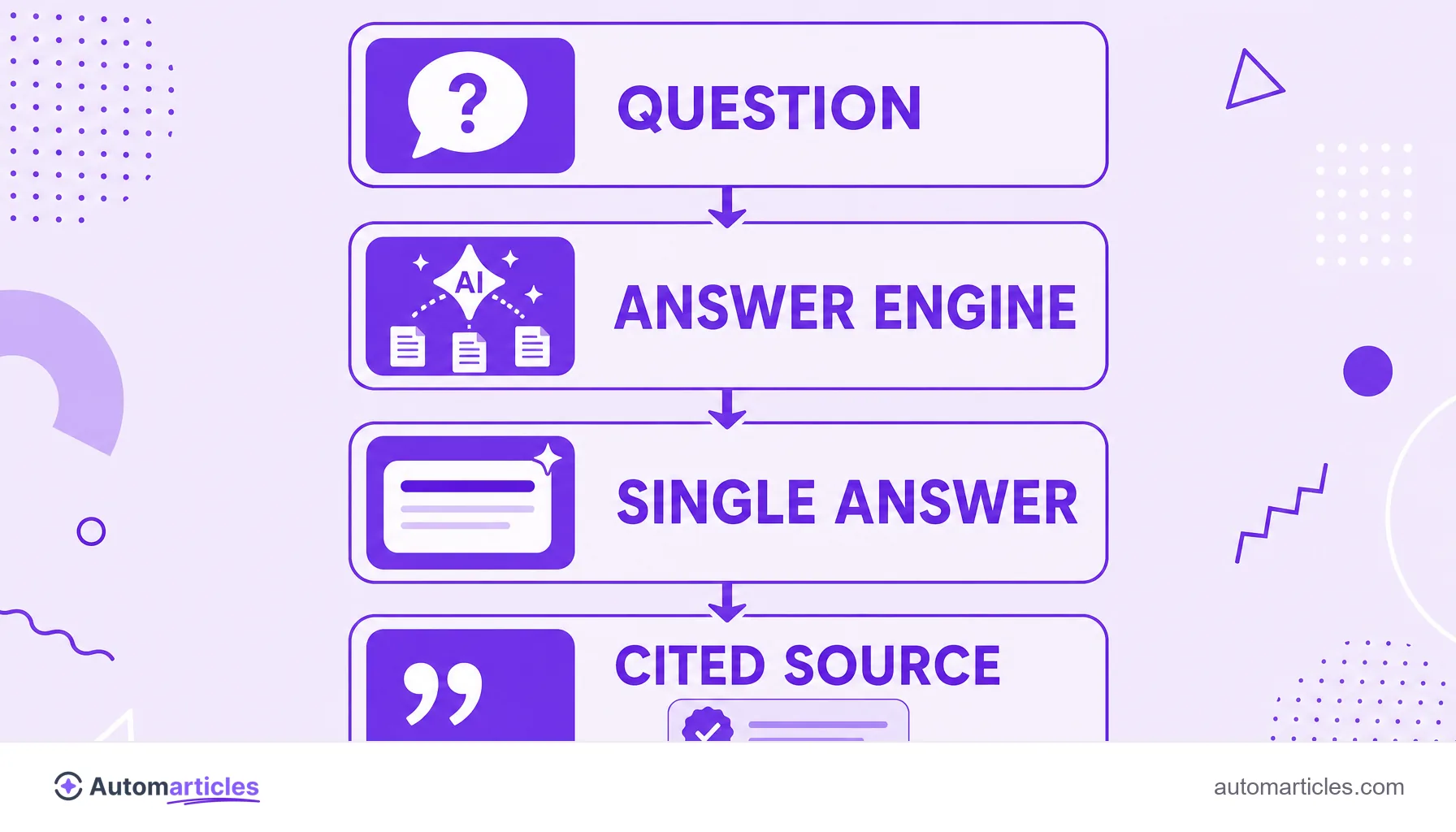
An answer engine does not return ten links, it returns an answer. To build it, it crawls and interprets several sources, extracts the most useful passages and synthesizes everything into a single text, often indicating where it took the information from.
This behavior is growing fast. A study by Semrush showed that Google's AI Overviews went from 6.49% of the analyzed keywords in January 2025 to nearly 25% in July of the same year, a sign that the direct answer is becoming standard in more and more searches.
When the search engine answers right there, many users click on nothing, the zero-click phenomenon. That is why AEO connects closely to GEO (Generative Engine Optimization): if the journey ends at the answer, being the source cited in it becomes worth as much as ranking first.
AEO vs SEO: what is the difference
AEO and SEO are not rivals, they are complementary layers. One takes care of the link, the other of the answer, and both start from the same well made content. The table helps separate the focus:
| Aspect | SEO | AEO |
|---|---|---|
| Goal | Rank the page and win the click. | Become the direct answer and get cited. |
| Where it shows | List of organic results. | AI Overviews, assistants, snippets, voice. |
| Main metric | Position and organic traffic. | Brand citations and mentions. |
| Ideal format | Complete, in depth page. | Objective, extractable answer. |
In practice, good AEO leans on good SEO. Without crawling, indexing and authority, the machine never even reaches your content. AEO adds a layer of clarity and structure on top of that base, designed for extraction.
Will AEO replace SEO?
The short answer is no. AEO does not replace SEO, it extends it into a new scenario where part of the answers happen without a click. The SEO fundamentals (useful content, solid technique and authority) remain what makes the machine trust your source.
What changes is the weight of each goal. As the click gets rarer, winning the citation starts to matter as much as winning the position. And when the answer engine links the source, that traffic exists: according to data from Semrush, the referral traffic ChatGPT sends to the rest of the web grew 206% in 2025.
Instead of choosing between SEO and AEO, the more sensible reading is to treat them as part of the same strategy. You keep optimizing to rank and, at the same time, structure the content to be the chosen answer when search turns into a conversation with AI.
How to build an AEO strategy
An AEO strategy organizes content the way the machine can read, understand and reuse. A roadmap that works:
- Start from real questions: map your audience's doubts, including People Also Ask, and write to answer them directly.
- Answer before going deep: open each section with a clear answer in one or two sentences, the format position zero rewards, and only then add detail.
- Structure for extraction: use objective headings, lists, tables and question and answer blocks that are easy to clip.
- Reinforce the technical side: apply structured data and schema markup so the machine understands the meaning of each passage.
- Prove authority: cite sources, use data and show E-E-A-T, because answer engines prefer sources they trust.
The principle is simple: the easier you make the reading for the machine, the higher the chance it chooses your content as the answer.

How to measure AEO and examples in practice
Measuring AEO is different from measuring clicks, because much of the value happens in the answer, without a visit to the site. Even so, you can track concrete signals:
- Citations in AI answers: test questions from your niche in ChatGPT, Perplexity and Google and see whether your brand shows up as a source. This is the basis of AI citation.
- AI visibility: AI visibility tools monitor how often you are mentioned in answers.
- Featured snippets: track how many keywords earn position zero for your content.
- Assistant traffic: watch the visits arriving from AI search engines and assistants when they cite the source.
A practical example: an FAQ page that answers each question in two sentences, with question and answer schema, has a much higher chance of becoming the source of an AI Overview than a long, unstructured text. AEO is, in the end, the art of writing to be cited.