
SEO: what it is, what it is for and how it works
By Tiago CostaUpdated on July 2, 2026

SEO (Search Engine Optimization) is the optimization of a site to appear better in the organic results of search engines. In practice, SEO rests on three fronts:
- on-page: content, keywords and page structure;
- off-page: reputation and links from other sites;
- technical: crawling, indexing and speed;
- the goal is to earn qualified traffic without paying per click.
What SEO (Search Engine Optimization) is
SEO stands for Search Engine Optimization. It is the set of techniques that helps a site appear in the top positions of the results page when someone searches for something related to your content.
Instead of buying space, as in paid media, SEO earns visibility organically: you adjust the site and the content so that the search engine itself considers them the best answer for a query. That is why results are slower to show up, but tend to last longer.
In practice, doing SEO means answering three questions from the search engine: can your site be read easily, is your content the best answer for the search, and do other people trust it enough to cite it. The better the answers, the better the position.
How SEO works: crawling, indexing and ranking
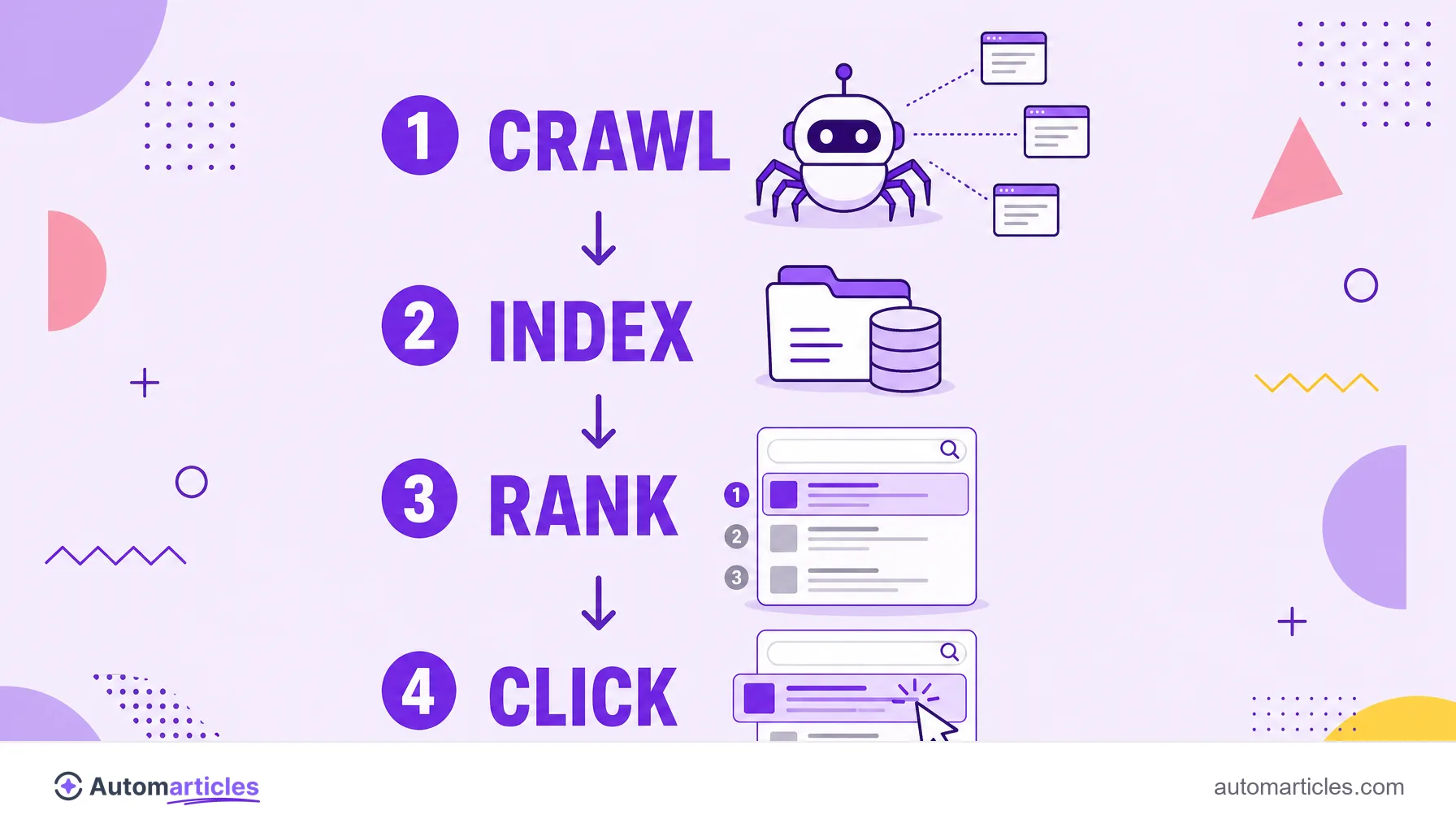
To understand SEO, it helps to know how a search engine works. The process has three linked stages:
- Crawling: bots (the crawlers) travel the web following links and collecting pages.
- Indexing: the search engine analyzes each page and files it in a giant index, understanding what it is about.
- Ranking: for every search, the algorithm chooses and orders, among the indexed pages, the ones that best answer the query.
SEO acts on all three stages: it makes sure the site is crawlable and indexable (the technical base) and makes the content deserve the top positions in ranking. If a page is neither crawled nor indexed, it simply does not exist for Google.
What SEO is for and why it matters
SEO is there to continuously attract people who are already looking for what you offer. It is one of the few channels where demand comes to you, at the exact moment of interest.
The size of that opportunity is large. According to BrightEdge, organic search accounts for around 53% of all website traffic, more than any other channel. And position matters a lot: the CTR study by Backlinko estimates that the first organic result gets around 27.6% of clicks, a share that drops sharply in the following positions.
The practical takeaway is simple: appearing well in search engines is not vanity, it is distribution. Good SEO work turns the site into a predictable source of organic traffic, without depending on paying for each visit.
The three pillars of SEO: on-page, off-page and technical
SEO is usually split into three big fronts that complement each other:
| Pillar | What it covers |
|---|---|
| On-page | On-page SEO takes care of content, keywords, titles and the structure of each page. |
| Off-page | Off-page SEO deals with reputation, especially the backlinks that other sites point to yours. |
| Technical | Technical SEO makes sure the site is fast, crawlable, indexable and well structured. |
No pillar sustains the result on its own. Excellent content on a slow site with no authority yields little, just as a technically flawless site with poor content has nothing to rank.

SEO and search intent: writing for the person searching
At the heart of modern SEO is a simple idea: deliver exactly what the person wants when they search. That begins with keyword research, which reveals which terms your audience uses and with what search intent.
Every keyword carries an expectation. Someone searching how to do something wants a tutorial; someone searching best tool for wants a comparison; someone searching buy wants a product page. Delivering the wrong format, however good the text is, hardly ranks.
That is why reading the intent before writing is worth more than stuffing the text with terms. SEO stopped being about repeating words and became about answering questions in a complete, clear and trustworthy way.
SEO in the age of AI: GEO and AI Overviews
Search is changing. Google now shows AI generated summaries (AI Overviews) at the top of many searches, answering right on the page, and assistants like ChatGPT have become a new starting point for questions.
This does not kill SEO, but it widens the game. GEO (Generative Engine Optimization) emerges, the optimization to be cited inside AI answers. The logic is close to SEO: clear, well structured and trustworthy content has more chance of being chosen as a source, now both by the search engine and by the models.
In practice, whoever already does good SEO, with objective answers, sourced data and a solid reputation, starts ahead in this new layer too. Ranking and being cited begin to move together.
How to start with SEO: a step by step
Getting started in SEO is less about tricks and more about method. An initial routine that works:
- Understand your audience: find out what they search for and with what intent.
- Choose the right words: prioritize terms with real demand and viable competition.
- Create the best content for each search: more complete, clear and useful than what already ranks.
- Take care of the technical base: speed, mobile version, crawling and indexing in order.
- Build authority: earn mentions and links and reinforce E-E-A-T signals (experience, expertise, authoritativeness and trust).
- Measure and adjust: track positions and traffic to know what to improve.
SEO is a medium term effort. The first results take weeks or months, but once earned, they sustain traffic for a long time at a low marginal cost.