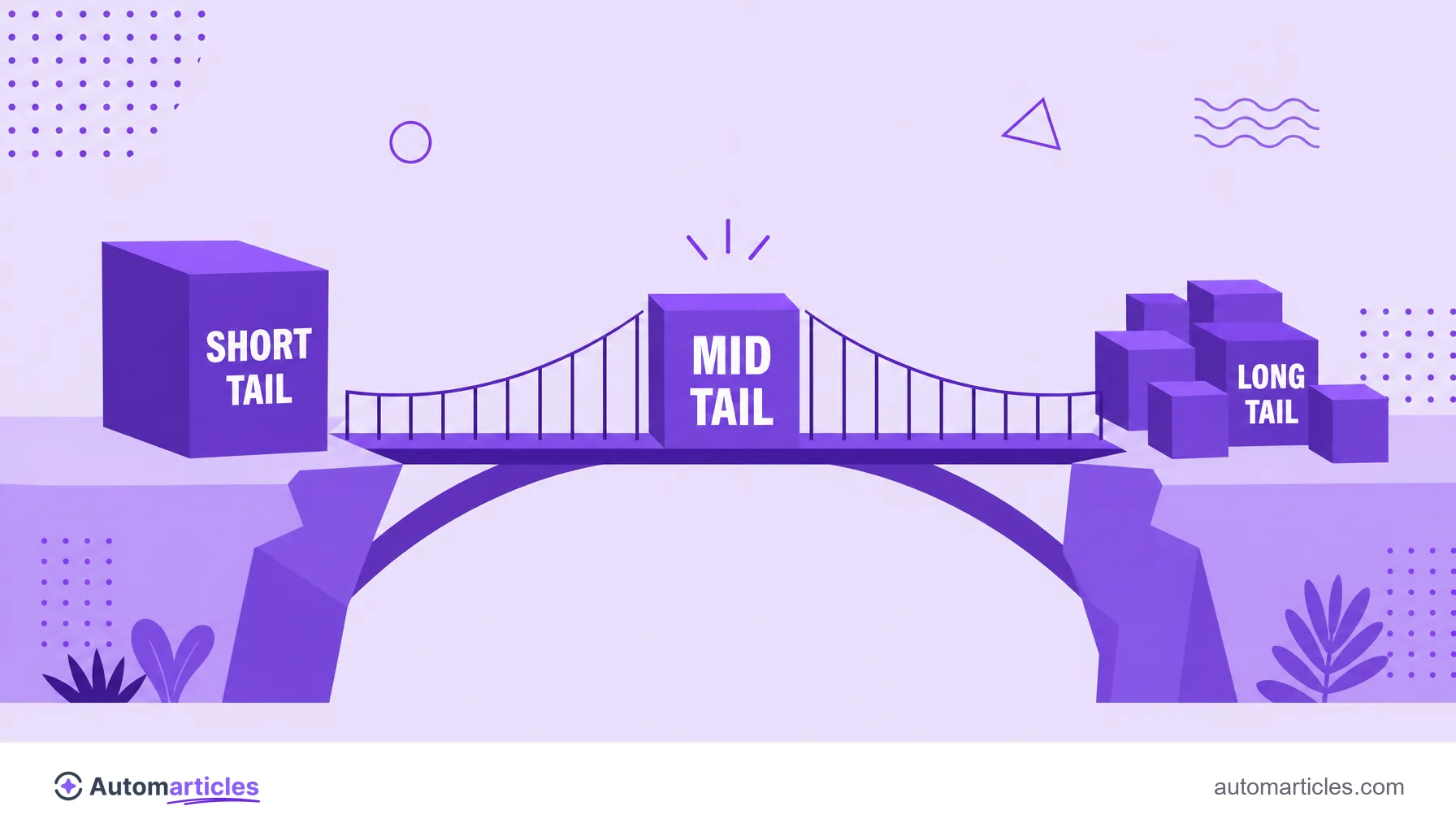
Mid-tail keywords: what they are and when to use them
By Tiago CostaUpdated on July 2, 2026

A mid-tail keyword is the intermediate term between the short tail and the long tail. It usually has:
- two to three words;
- moderate search volume;
- medium competition;
- a more defined intent than a head term.
What is a mid-tail keyword
A mid-tail keyword (also called medium tail) is the type of keyword that sits in the middle of the demand curve, between generic terms and very specific searches. It usually has two to three words, like running shoes or content marketing.
It is more specific than the short tail, so it already reveals better what the person wants, but it is not yet as narrow as the long tail. This middle ground reflects in the search intent: neither so vague that you cannot tell where to point the content, nor so narrow that it only serves a very specific case.
In practice, the mid tail is the natural step for those who have already moved off zero on the long tail and want terms with more traffic, without facing the giants' competition head-on.
The full curve: short, mid and long tail
The best way to place the mid tail is to see the three sizes side by side:
| Type | Length | Volume | Competition | Example |
|---|---|---|---|---|
| Short tail | 1 to 2 words | High | Very high | shoes |
| Mid tail | 2 to 3 words | Medium | Medium | running shoes |
| Long tail | 3 or more | Low | Low | running shoes for overpronation |
Notice that the mid tail inherits a bit of each neighbor: more volume than the long one, less competition than the short one. It is this combination that makes it so strategic once the site starts gaining authority.
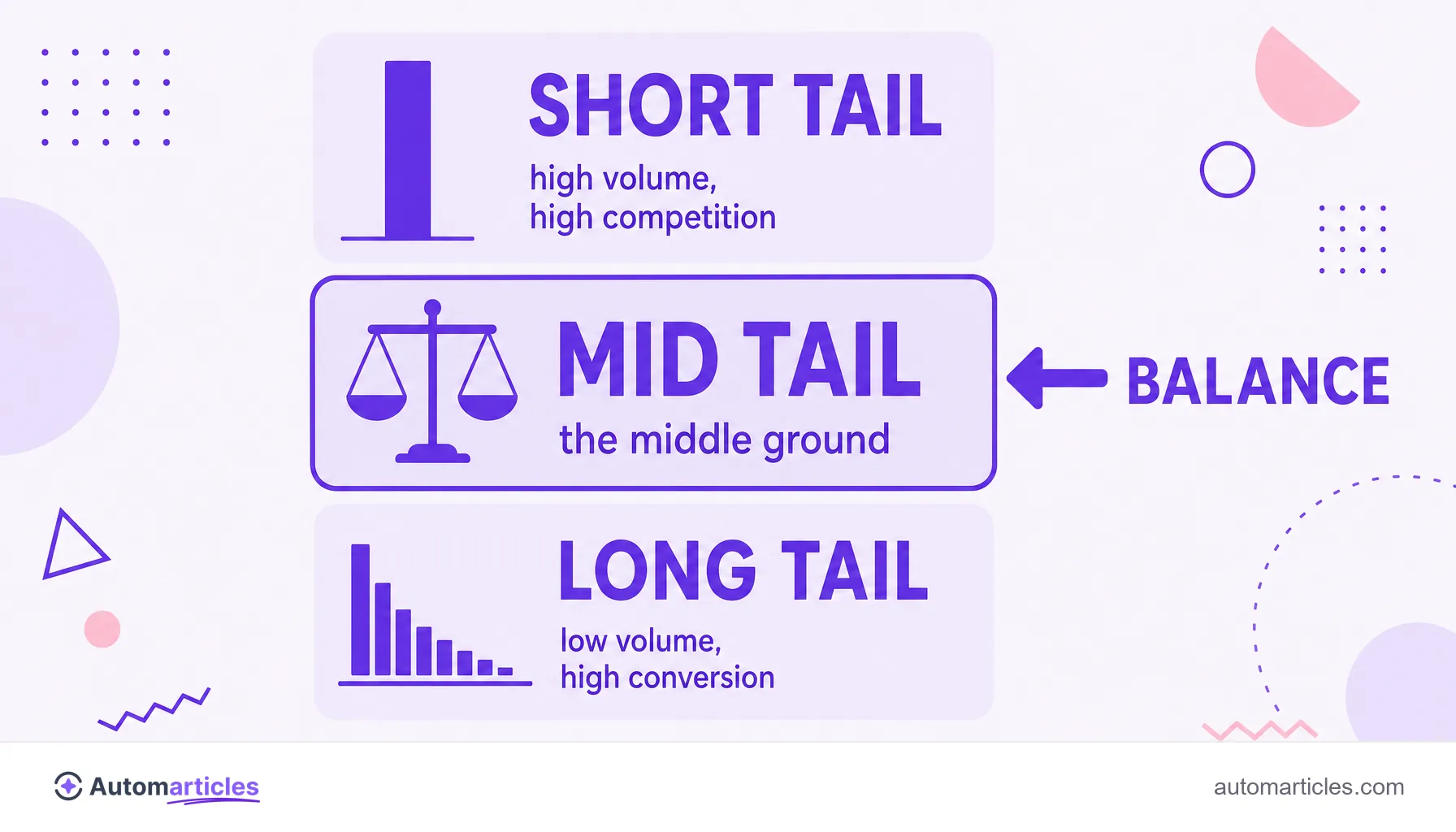
The balance point between volume and competition
The mid tail occupies the core of the demand curve, and that is precisely where the balance lives. The data helps to see why. In the study of 306 million terms by Backlinko, 91.8% of keywords are long tail, with very little volume each, and that whole tail combined is worth only 3.3% of the search. At the other extreme, Ahrefs found fewer than 18,000 terms with more than 100,000 monthly searches in its United States database, a tiny and heavily contested head.
The mid tail sits between these two worlds: it has relevant volume, without being negligible like that of a single niche search, and a keyword difficulty much lower than that of the head terms. It is the kind of search volume worth pursuing once the site already has some traction and wants to accelerate without going head-to-head with the biggest competitors.
When to use mid-tail keywords
The mid tail shines at a few specific moments:
- After the first wins: when the site already ranks for several long-tail terms and has earned the authority to aim for more volume.
- To scale traffic: a single mid-tail term can be worth dozens of long-tail searches combined.
- As a category or subtopic: mid-tail terms often organize entire sections of a blog.
- When the intent is commercial: many mid-tail searches (best running shoes) reveal someone comparing before buying.
Before aiming at a mid-tail term, it is worth checking who is already ranking. If the top positions are still dominated by much larger brands, it may be better to mature a bit more on the long tail first.
How to find and prioritize mid-tail terms
Mid-tail terms appear naturally when you expand a broad theme. The path:
- Start from a seed: use a generic seed keyword and let the tool generate two and three word variations.
- Filter the middle of the curve: in a good keyword research, sort by volume and look for terms with relevant traffic and still accessible difficulty.
- Check the real competition: open the term's SERP and confirm whether sites your size already appear in the top positions.
Prioritization follows a simple logic: between two terms of similar volume, choose the one with lower difficulty and greater alignment with what your audience wants.
The mid tail in your content strategy
The mid tail works best as a bridge within a larger structure, not as a loose bet:
- Connect the extremes: it links long-tail articles to a broader page, helping Google understand the relationship between them.
- Feed the cluster: several mid-tail terms support a strong content cluster around a central theme.
- Follow the funnel: use the mid tail for the comparison moment, while the long tail closes the more specific intent.
Combined with the other two sizes, the mid tail accelerates growth without requiring the giant authority that head terms demand, a sustainable path to gaining organic traffic.