
Seed keyword: what it is and how to use it in SEO research
By Tiago CostaUpdated on July 2, 2026

A seed keyword is the initial, broad term used as the starting point in keyword research. In practice, it serves to:
- plant the search from a broad topic;
- generate hundreds of variations and questions;
- feed the SEO tools;
- open up a topic's map of content opportunities.
What is a seed keyword
A seed keyword is the initial, broad term you use as a starting point in keyword research. It is usually short and generic, like coffee, running or marketing, and it serves to plant the search: from it, the tools reveal a universe of related terms.
The seed is rarely the keyword you will target directly, because broad terms are very competitive. Its role is different: to open up the range. From a seed come variations, questions, synonyms and specific searches that become the raw material of your content calendar.
Think of the seed as the root of the tree. You do not harvest fruit from the root, but it is from there that all the branches that will bear fruit later are born.
Seed keyword or Bitcoin seed phrase: do not confuse them
If you searched for the term, you probably noticed that a good part of the results talk about cryptocurrencies. It is worth clarifying the difference, because these are unrelated concepts.
In the world of digital wallets, the seed phrase (or recovery phrase) is a sequence of words that grants access to the funds of a cryptocurrency wallet. It is a security mechanism, nothing to do with search. Those 12 Bitcoin words belong to that context.
In this glossary, seed keyword always means the starting term of an SEO research. Whenever the expression appears here, it is this concept we are talking about: the trigger that expands the discovery of new keywords.
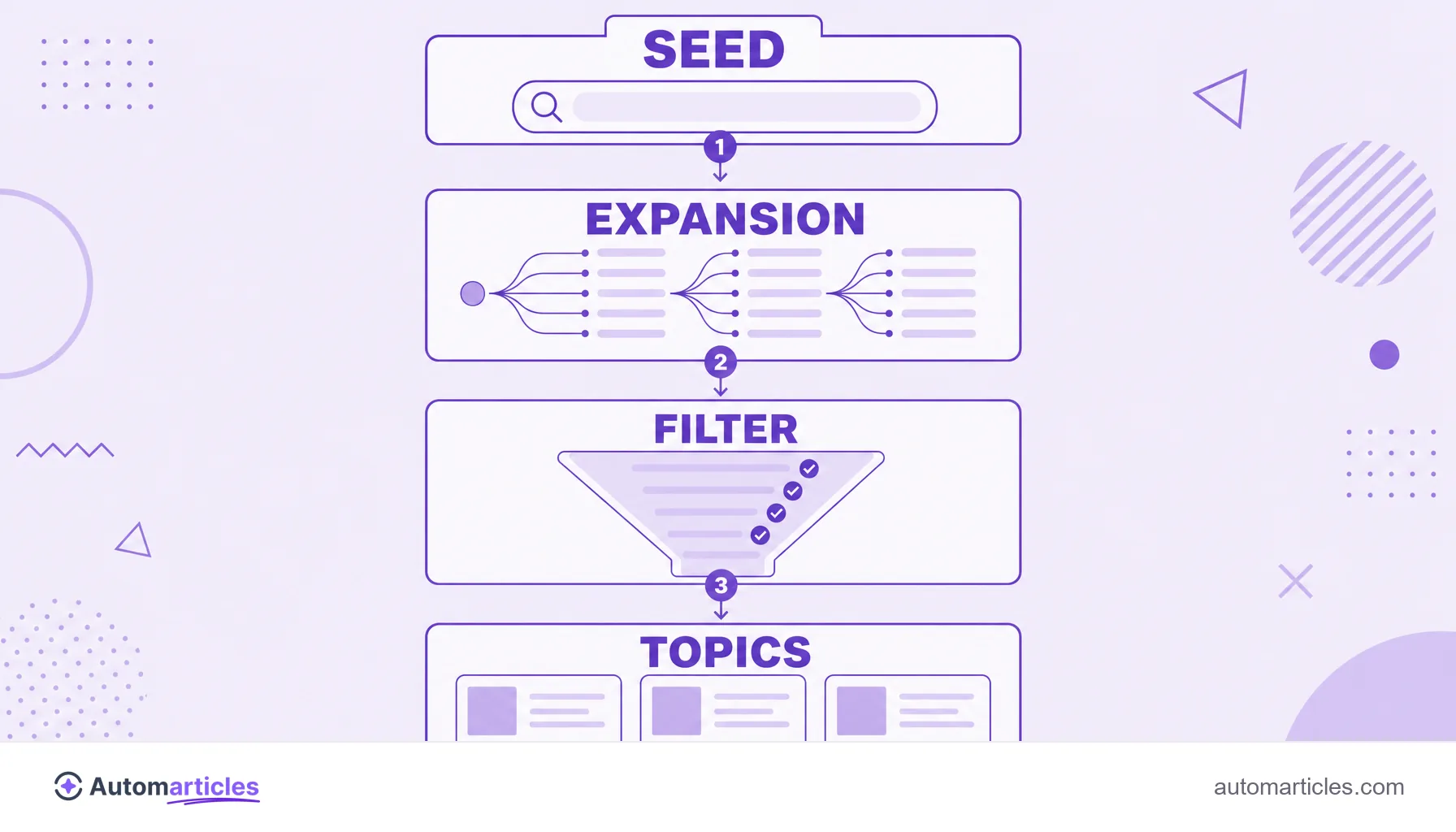
How a single seed becomes hundreds of keywords
The power of the seed is in the scale. The universe of terms behind any subject is gigantic. In its United States database alone, Ahrefs counts around 2.3 billion keywords with fewer than 10 monthly searches, and the study of 306 million terms by Backlinko shows that 91.8% of all searches are long tail, specific and derived from broad themes.
Translating into practice: a seed like coffee can unfold into how to make pour over coffee, is specialty coffee worth it and difference between arabica and robusta coffee, among thousands of other variations. Each of those branches is a potential long-tail keyword, and the seed was just the trigger that opened up that map.
Seed, head and long tail: where the seed fits
To avoid mixing up the keyword types, it helps to see side by side how the seed sits in relation to head terms (short tail) and the long-tail terms that grow from it:
| Type | Example | Search volume | Role in the strategy |
|---|---|---|---|
| Head (short tail) | marketing | Very high | Broad and too competitive; it sets the theme, but is rarely the direct target. |
| Seed | content marketing | High | The trigger of the research; it is where the variations and questions come from. |
| Long tail | how to build a content marketing calendar | Low | The real target of the content, easier to rank and to convert. |
Notice that the seed usually sits in the middle: broad enough to spawn many branches, but rarely specific enough to be the final destination of the content.
How to choose good seed keywords
A good seed is broad enough to yield many branches, but relevant enough not to stray from your niche. Some criteria:
- Start from your business: list the big themes you master and that connect to what you offer.
- Prefer broad but niche-specific terms: the seed needs to open many branches without becoming too generic.
- Think about intent: good seeds cross different types of search intent, from informational to transactional.
- Use competitors' terms: the categories and themes they work on make great seeds.
A short seed is usually, itself, a short-tail keyword. You do not need to rank for it, just use it as an entry point.

How to expand the seed in practice
With the seed in hand, it is time to multiply it. The most efficient paths:
- Google autocomplete: type the seed and watch the automatic suggestions.
- People Also Ask: the People Also Ask block returns real questions around the topic.
- Related searches: the SERP footer brings the related searches block with variations.
- SEO tools: when you enter the seed, they list hundreds of terms with search volume and difficulty, including many mid-tail ones.
The result is a long list that you filter by volume, competition and relevance until only what is really worth writing remains.
From seed to content: building the strategy
Discovering terms is just the beginning. The value appears when you organize a seed's branches into a structure:
- Group by theme: the variations of the same seed form a cohesive content cluster.
- Distribute across sizes: combine short-tail, mid-tail and long-tail terms to cover the topic in depth.
- Prioritize by intent and stage: start with what is most aligned with your audience and your site's moment.
This way, the seed keyword fulfills its role: it is not the destination, it is the first piece of a map that guides months of content.